Jewish Tours PortugalA Portugal Magik Division
    Trancoso by Private Driver
    Driver Services — Beira Interior

    Trancoso by Private Driver

    Trancoso is a walled medieval town on the high plateau of the Beira interior, and one of the most rewarding stops on a Jewish heritage journey in Portugal. It lies far from any rail line and well off the main coastal routes, so a private driver-guide is the practical way to reach it and the best way to understand it.

    Trancoso and its Jewish past

    Trancoso had a significant Jewish community in the late Middle Ages, living in a quarter within the town walls. Like other communities in the region, it was transformed by the forced conversions of 1497, after which its families lived as New Christians. The proximity of the Spanish border and the remoteness of the plateau helped some families preserve elements of Jewish identity in private for generations.

    The town is also associated with Gonçalo Anes Bandarra, a sixteenth-century shoemaker whose prophetic verses circulated widely in Portugal and were later read by many, including New Christians, through a messianic lens. He was investigated by the Inquisition. The driver-guide can explain his significance in the broader story of the period while making clear where history ends and later legend begins.

    Today the historic centre preserves a remarkable concentration of medieval and early modern buildings. Doorways with carved symbols, the layout of the former quarter and the walls themselves give the visit a strong sense of place.

    The Isaac Cardoso Interpretation Centre

    The Isaac Cardoso Jewish Interpretation Centre is the main point of orientation for Jewish history in Trancoso. It is named after Isaac Cardoso, a seventeenth-century physician and philosopher born in Trancoso to a New Christian family, who later left Iberia, embraced Judaism openly and wrote a defence of the Jewish people while living in Verona.

    The centre presents the history of the town's Jewish community and its wider context, and includes a space conceived as a synagogue in contemporary form. Its displays help visitors understand the sequence of expulsion, conversion, Inquisition and dispersal that shaped families like Cardoso's.

    A plaque in the town commemorates Cardoso. The driver-guide can bring guests to the centre first for context and then into the streets, so that what they see outside is already framed by what they have learned inside.

    Reading the streets

    One of the most discussed buildings in Trancoso is the so-called Casa do Gato Preto, the House of the Black Cat, whose facade carries carved imagery that has been interpreted in relation to Jewish symbolism. Interpretations of such carvings vary, and a careful driver-guide presents them as interpretations rather than certainties.

    Throughout the old town, travellers notice doorways with two openings of different widths, a common late-medieval arrangement for combining shop and home, and occasional carved marks on lintels and doorposts. Some of these have been linked by researchers to New Christian households; others are simply decorative or devotional. Learning to look carefully, and to distinguish evidence from speculation, is part of the experience.

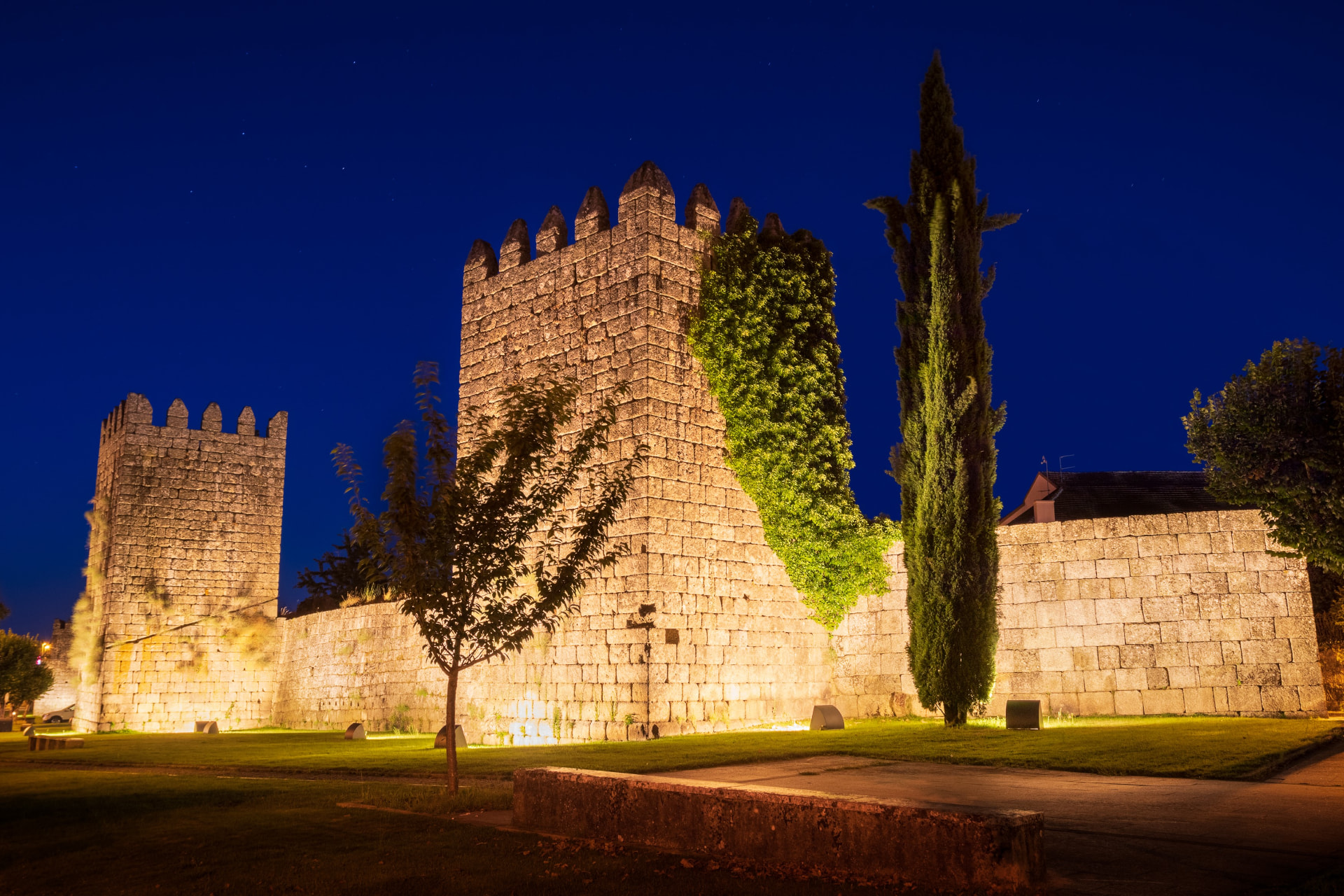
    The walls and the castle frame the town, and a walk along them gives a clear view of how compact the medieval settlement was.

    Getting there

    From Lisbon, Trancoso is roughly 340 kilometres and between three and a half and four hours by road. From Porto it is closer, around two hours. Most heritage journeys therefore reach Trancoso as part of a circuit through the Beira interior rather than as a single excursion.

    A common sequence combines Belmonte and Trancoso, which are around an hour and a quarter apart, with an overnight stay in the region. Another links Trancoso with the Douro valley to the north, combining heritage with wine country.

    The final approach crosses the granite plateau, a high, open landscape of boulders and small fields that gives a sense of the isolation in which these communities lived.

    Nearby places worth adding

    Trancoso belongs to a network of historic fortified villages in the region. Nearby are Marialva, with its ruined castle and medieval village, and Pinhel and Almeida, the latter a star-shaped fortress town near the border. Each has its own history, and some had Jewish residents in the medieval period.

    Guarda, the highest city in Portugal, lies to the south and preserves an area of its former Jewish quarter near the cathedral. Vilar Formoso, on the Spanish border, is home to a memorial museum dedicated to refugees who entered Portugal during the Second World War.

    A driver-guide can combine these according to the time available, keeping daily drives comfortable.

    Practical notes

    Trancoso's historic centre is mostly walkable and less steep than many hill towns, which makes it suitable for most travellers. The driver can set guests down at one of the gates and collect them at another.

    Opening hours at the interpretation centre vary, and the site may close on certain days. The driver confirms them in advance and plans the day around them.

    The plateau is cold in winter and can be hot in summer. Spring and autumn are particularly pleasant, and evenings at any time of year are quiet and atmospheric, especially when the walls are lit.

    Trancoso in the Inquisition period

    After the establishment of the Portuguese Inquisition in 1536, New Christian families across the Beira interior lived under the risk of denunciation. Trials affected communities throughout the region, and Inquisition records are among the most important sources historians have for understanding crypto-Jewish life in towns like Trancoso.

    Many families eventually left. Some reached Amsterdam, Hamburg, London, Bordeaux or Italy, where they could live openly as Jews. Isaac Cardoso's path to Verona is one example; his brother Abraham, also a physician, followed a related path. Their story shows how a single Beira town connects to the wider Sephardic diaspora.

    A driver-guide can trace this arc on the road, helping travellers see Trancoso as a point of departure as much as a place of memory.

    Staying overnight in Trancoso

    Trancoso has comfortable hotels, including properties within or close to the walls. An overnight stay allows the town to be seen in the evening, when the walls are lit and the streets are quiet, and in the early morning before day visitors arrive.

    For travellers who prefer a base with more facilities, Guarda lies around half an hour to the south.

    The driver coordinates hotel arrivals and luggage, including in the walled centre where vehicle access is limited.

    Combining Trancoso and the Douro

    Trancoso is around an hour south of the upper Douro, which makes it easy to pair a heritage visit with wine country. A day can begin at a Douro quinta, continue with lunch and arrive in Trancoso by mid-afternoon, or the reverse.

    The contrast between the river valley's terraced vineyards and the granite plateau is striking, and it helps travellers understand the varied landscapes in which New Christian families lived and traded.

    This combination is part of our ten-day journey and can be included in tailor-made itineraries.

    Trancoso's festivals and quiet days

    Trancoso hosts events through the year, including a medieval fair, during which the town becomes busier and more festive. Outside these periods, it is notably quiet. The driver can advise whether a planned date coincides with a festival and adjust timings accordingly.

    For most heritage travellers, the quiet days are preferable, allowing the streets and the interpretation centre to be explored without crowds.

    Photography in Trancoso

    Trancoso is particularly photogenic: the walls and gates, the carved doorways and the castle. Early morning and late afternoon give the best light. The driver can suggest viewpoints and timing, and can return to a particular spot if the light improves later in the day.

    Food on the plateau

    The cooking of the Beira plateau is simple and generous: roast meats, sausages, bean dishes, mountain cheeses and local bread. Trancoso is also known for a traditional sweet, the sardinhas doces, shaped like small fish and made with almonds and eggs. The driver can recommend a restaurant for lunch inside or near the walls, so that the afternoon continues without rushing.

    The plateau landscape

    The approach to Trancoso crosses a high granite plateau scattered with boulders, stone walls and small fields. It is an austere, beautiful landscape, and seeing it from the road helps travellers understand how remote these towns once were, and why communities here could maintain private traditions far from the centres of power. The driver can pause at a viewpoint so that guests can take in the scale of the plateau before entering the walls.

    Trancoso in our journeys

    Trancoso is included in our three-day Sephardic Route and in the six-, ten- and fourteen-day journeys. In longer journeys it is usually visited alongside Belmonte and Guarda, with an overnight in the Beira interior.

    For travellers interested in the intellectual history of the Sephardic diaspora, figures such as Isaac Cardoso make Trancoso a natural focus for a tailor-made itinerary.

    In every case, a private driver-guide removes the logistical difficulty of reaching the town and adds the context that makes it meaningful.

    Practical Points

    • —Isaac Cardoso Jewish Interpretation Centre
    • —Walled medieval town on the Beira plateau
    • —Casa do Gato Preto and carved doorways
    • —Story of Gonçalo Anes Bandarra
    • —Pairs naturally with Belmonte, Guarda and the Douro
    • —Nearby fortified villages of Marialva and Almeida

    Frequently Asked

    How far is Trancoso from Lisbon?

    Roughly 340 kilometres, three and a half to four hours by road. From Porto it is around two hours.

    Who was Isaac Cardoso?

    A seventeenth-century physician and philosopher born in Trancoso to a New Christian family, who later lived openly as a Jew in Italy.

    Is Trancoso hard to walk?

    Its centre is relatively level for a hill town and generally comfortable to walk.

    Can we visit Trancoso and Belmonte the same day?

    Yes, they are about an hour and a quarter apart. An overnight in the region is recommended.

    Get Started

    Begin Your Private Jewish Heritage Journey

    Share your plans — we cover the whole country with private tours, transfers and curated experiences.

    Tell us your dates, group size and interests so we can craft the perfect experience.

    Select Your Journey *